Fundamental Science
How pictures can help school students learn quantum physics
Apr 13, 2026, 10:00 AM
出典: Physics World
<p><strong>Muhammad Sabieh Anwar</strong> describes a new way to engage students in quantum physics</p>
<p>The post <a href="https://physicsworld.com/a/how-pictures-can-help-school-students-learn-quantum-physics/">How pictures can help school students learn quantum physics</a> appeared first on <a href="https://physicsworld.com">Physics World</a>.</p>
Details
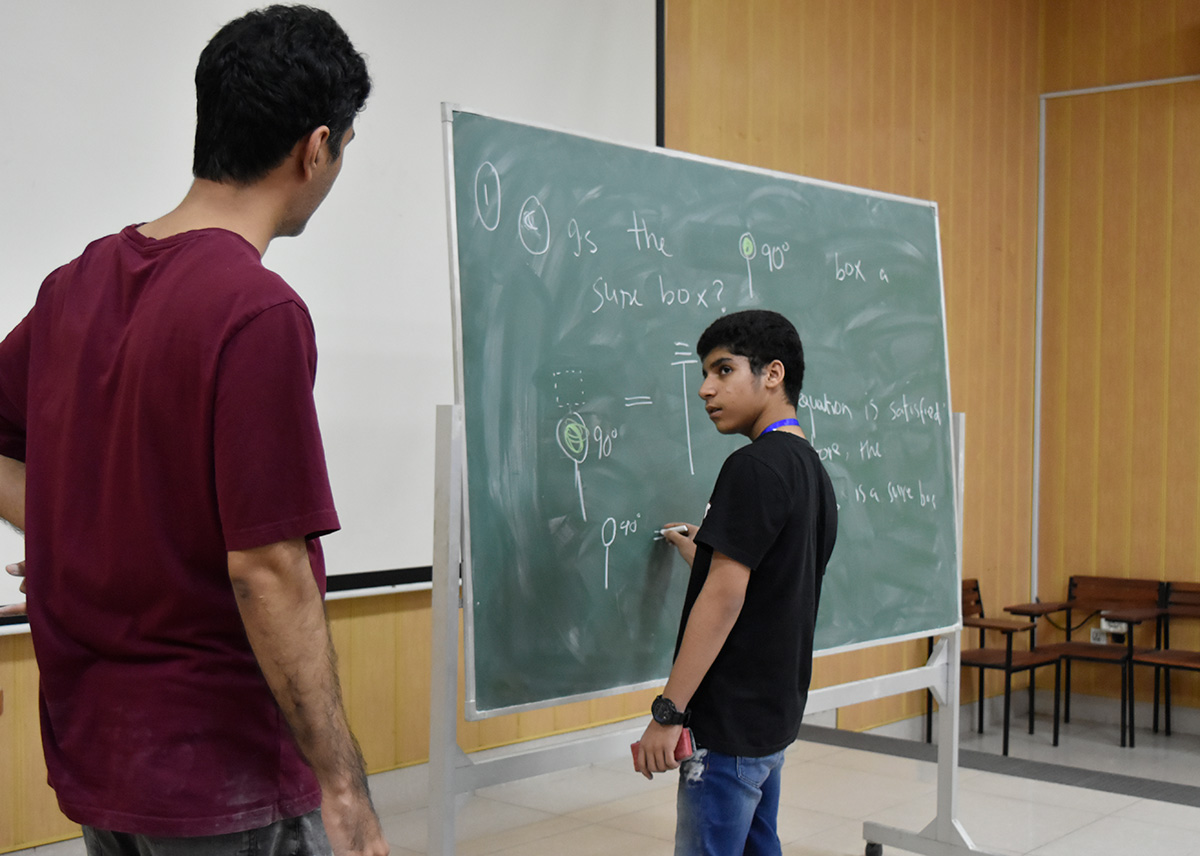
Humans perceive knowledge, make decisions and build the consciousness of knowing through vision and speech. This interplay between visual and nonvisual patterns collectively shapes how we learn complex concepts such as quantum physics. That is despite the subject’s reputation as being incomprehensible and difficult to reconcile with our everyday conceptions.
The issue when teaching quantum mechanics also lies in the shortcoming of using literary constructs to accurately describe what quantum mechanics really means. As the Hungarian-British philosopher Michael Polanyi once noted: “We always know more than we can tell.” It is hard to accurately capture in language the full meaning of quantum phenomena such as nonlocality, superposition, no-cloning, teleportation, counterfactual quantum computation, delayed choice or the many other uniquely quantum phenomena.
This also means that terms such as wave, particle, superposition and entanglement are not truly complete until followed by detailed calculations or elaboration of their consequences. The result is that introductory quantum mechanics courses often require prerequisite mathematical grounding in complex numbers, matrices, linear algebra and differential equations.
Yet I believe this tortuous preparation can be bypassed – in an accurate, comprehensive and consistent way – simply through “pictures”. With that in mind, we conducted an experiment last year at Government College University in Lahore, Pakistan – alma mater of the physics Nobel laureate Abdus Salam. The four-week-long summer school – Quantum in Pictures – was organized by the Khwarizmi Science Society, a not-for-profit grassroots science association that aims to make scientific education accessible especially for resource-deprived communities.
Some 50 school students attended lectures and demonstrations led by Muhammad Hamza Waseem from the UK firm Quantinuum, who works with Bob Coecke, one of the founders of a pictorial approach towards quantum physics and education.
Most of the students, who had no prior knowledge of quantum mechanics, came from Lahore while the remainder were from nearby towns and villages where opportunities especially in advanced fields are generally minimal. On top of that classroom engagement is largely discouraged and an outdated model of examination fosters rote learning. Almost half of the participants who attended the school were girls, with 75% of participants aged between 14 and 18 – the youngest being a 13-year-old girl from a village called Syedanwala in Kasur.

To capture ideas about quantum mechanics, we used “string diagrams” as our basis. Such diagrams, simply put, are made using boxes that represent processes. Wires coming in at the top and at the bottom represent the input and output systems being processed by the box. Simulating quantum processes translates to connecting boxes with wires, chopping and straightening wires or sliding boxes along wires like beads on a string.
Even though this formalism is rigorous and derived from category theory, the manner in which it is presented is unhindered by burdensome abstractions. In terms of quantum mechanics, such diagrams are able to capture ideas about how quantum states transform, how quantum operations work as well as counterintuitive notions about measurement.
A new confidence
When I teach quantum mechanics to undergraduates, colleagues often discourage me from “spilling the beans” on quantum mechanics too early before we have covered the mathematical acrobatics of Hilbert spaces, unitary transforms, eigenvalues and Dirac’s bra-ket notation. Yet I believe school students should relish the counterintuitive repercussions of quantum mechanics much earlier than they currently do. I believe that introducing such aesthetic visuals – an overlooked concept for learning – can make the discipline more comprehensible and attractive to students.
A diagrammatic technique helps to avoid all this and democratizes the knowledge of our quantum world. After all, the future quantum workforce must be trained earlier than ever, given we do not want students missing out on the quantum revolution. In addition, quantum computing is not the purview of physicists alone. Many computer scientists and programmers, who will never be formally trained in physics, will need an initiation in quantum mechanics.
When it comes to making education accessible and within the direct grasp of millions of eager learners, demystifying traditional modes of learning and introducing new approaches helps students and teachers. Learners gain the confidence to ask questions, synthesize connections between bodies of knowledge and prepare themselves for a workforce that may require competency instead of a paper degree.
According to a survey of students who completed the course, 60% engaged in interactive discussions or used the chalkboard to solve problems while 80% asked or responded to questions. For most of these students, this level of engagement with the instructor was a first in their lives. This is the confidence that our liberated students walked away with as they completed their final exams in the Quantum in Pictures summer school.
The post How pictures can help school students learn quantum physics appeared first on Physics World.