Fundamental Science
Lure of the black hole: from science to art
Apr 14, 2026, 2:30 PM
出典: Physics World
<p>An excerpt from art historian and author <strong>Lynn Gamwell</strong>’s book <em>Conjuring the Void: the Art of Black Holes</em></p>
<p>The post <a href="https://physicsworld.com/a/lure-of-the-black-hole-from-science-to-art/">Lure of the black hole: from science to art</a> appeared first on <a href="https://physicsworld.com">Physics World</a>.</p>
Details
Black holes, as their name suggests, are veiled in darkness and mystery. These brooding celestial behemoths are regions of space–time that consume not just stellar dust and light but the attention of astronomers, artists and non-scientists too. Often depicted as shadowy maws ringed by fire, these inescapable pits intrigue us all.
“Science has produced a wealth of information about black holes that has been popularized worldwide,” says author, curator and art historian Lynn Gamwell. “This has prompted artists to delve deep into their creative imaginations to find the significance of black holes within a broad cultural context.”
Unable to escape from the lure of black holes herself, Gamwell – who teaches the history of art, science and mathematics at the School of Visual Arts in New York – has written and compiled Conjuring the Void: the Art of Black Holes. The stunning coffee-table book is a definitive – and near-exhaustive – collection of black-hole art, including 155 colour illustrations, perfectly mixed with information about the science and history of these objects.
Readers will undoubtedly fall into the pull of the book’s gravity, in which Gamwell skilfully weaves together our scientific understanding of black holes along with interpretations of these regions of space–time by artists around the world. Indeed, the book uses every medium available to decipher these objects.
With a background in the arts and humanities, Gamwell’s interest in science came while studying modern art. “The explanations of abstract, non-objective art that were taught to me never made sense,” she says. “While it seems so obvious now, I finally figured out that artists express their worldview and the modern worldview is shaped by science, which discovered invisible forces – such as electromagnetism – that can’t be pictured.”
Gamwell’s previous books – Mathematics and Art (2015) and Exploring the Invisible (2020) – both focused on the more abstract aspects of maths and science that are often complex and difficult to visualize. A few years ago, she was invited by physicist Peter Galison, director of Harvard University’s Black Hole Initiative (BHI), to give a talk at its annual conference.
“In researching for the talk, I was amazed to learn how many artists had done art about black holes,” Gamwell recalls. “So I decided to write a book about the artistic phenomenon and why black holes have captured the public imagination.” Gamwell is now an affiliate of the BHI, which brings together scientists, mathematicians and philosophers of science to deepen our understanding of black holes.
Given the interdisciplinary nature of her work, Gamwell regularly meets artists interested in science as well as scientists interested in art, including the Event Horizon Telescope’s Shep Doeleman, whom this book is dedicated to. “Artists and scientists arrive at similar ideas by different paths,” she says. “Both benefit from looking at each other’s work.”
The art – and, by extension, the artists depicted in Conjuring the Void – shows how the human conceit of “nothingness” links us to black holes. “On the one hand, the black hole provides artists with a symbol to express the devastations and anxieties of the modern world,” Gamwell writes. “On the other hand, a black hole’s extreme gravity is the source of stupendous energy, and artists such as Yambe Tam invite viewers to embrace darkness as a path to transformation, awe, and wonder.”
Below is an edited extract from chapter three of Conjuring the Void, illustrated by a selection of images of art from the book. They depict everything from colliding black holes and their gravitational waves to a black hole’s accretion disc and even a sonic wormhole. We hope they also take you on a journey of awe and wonder.
Artistic and scientific images of invisible objects
In the early 1970s the existence of black holes was reported in scientific papers and newspapers around the world, starting with the discovery of Cygnus X-1, introducing the phenomenon to the culture’s imagination. Scientists symbolized data in charts, graphs and mathematical formulae and attempted to make images of black holes. But seeing an object requires light, so rather than depicting a black hole itself, scientists imagined what matter surrounding it would look like. Artists, in turn, subjected scientific data to the transformation of the imaginative process and created something completely new: artworks.
Seeing an object requires light, so rather than depicting a black hole itself, scientists imagined what matter surrounding it would look like. Artists, in turn, subjected scientific data to the transformation of the imaginative process and created something new
Lynn Gamwell
In the decades before scientists showed that black holes exist, several artists in the West –including the American Barnett Newman, the Argentine-Italian Lucio Fontana, the American Lee Bontecou, and the Englishman John Latham – made abstract art about dark voids.
As scientists were confirming the existence of black holes, Frederick Eversley was imagining sculptures of them. He graduated in 1963 from the Carnegie Institute of Technology (now Carnegie Mellon University) in Pittsburgh with a degree in engineering and worked in the aerospace industry building acoustic laboratories for NASA. Around 1970 he transitioned to being an artist, creating abstract sculptures in cast polyester. With his background in science, Eversley understood the significance of the discovery of Cygnus X-1 in 1971.
That same year, the Brazilian artist Anna Maria Maiolino began a series of artworks about her life under Brazil’s military dictatorship. Whereas most artists in the early 1970s didn’t pay much attention to black holes because there were no visualizations of them to fire their imaginations, Maiolino became fascinated with holes filled with darkness.
Black holes were a metaphor for resistance to political repression in the work of Rudolf Sikora – in his case, from the Communist government of Czechoslovakia. In the early 1970s he began a series called Concentration of Energy featuring black holes.
Early scientific images of black holes
While Eversley, Maiolino and Sikora were in their studios making artworks about black holes, the US physicists C T Cunningham and James Bardeen were in their laboratory creating an illustration of the deformations in space–time around a black hole. They imagined a distant observer seeing a star orbiting a black hole at a uniform distance. They knew that the rapidly rotating black hole’s gravity affects light passing through its gravitational field in a manner similar to a powerful lens, hence the observer would see light that is distorted by what astronomers call gravitational lensing. Cunningham and Bardeen calculated these optical deformations and in 1973 produced the first scientific visualization of space–time around a black hole.
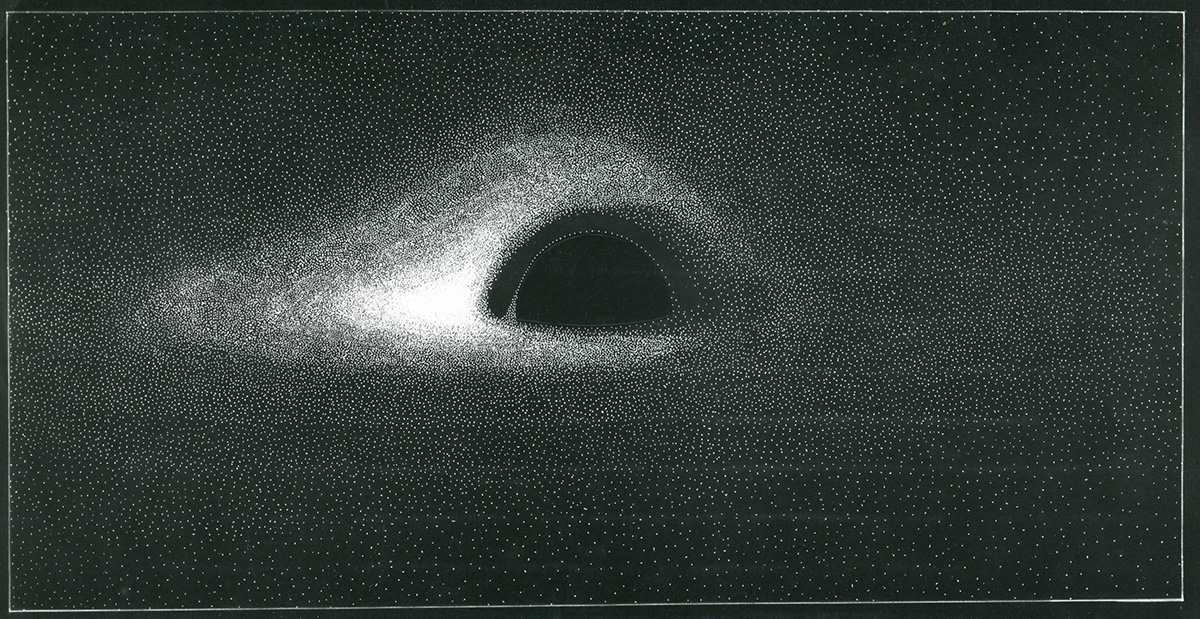
What would gravitational lensing do to the cloud of dust and gas that orbits a black hole called the accretion disc? The French astrophysicist Jean-Pierre Luminet wanted to make a realistic picture of an accretion disc. Associating realism with photography, he imagined the black hole “as seen by a distant observer” taking a “photograph” from a stationary, authoritative viewpoint. In Luminet’s diagram (see above), the accretion disc forms a flat, circular disc of dust and gas. Friction and magnetic forces heat the accretion disc to hundreds of billions of degrees until it becomes an incandescent plasma emitting radiation. The observer looks down on the disc from a slightly elevated position (at a 10-degree angle, labelled “observer’s direction”). While the accretion disc and stars emit light in all directions, for simplicity’s sake Luminet imagined parallel light rays coming from the observer’s direction.
Luminet made his drawing with tiny dots of black ink on white paper and then photographically reversed the image so that it reads white against a black background to create a “simulated photograph” of a luminous object in the darkness of space. His drawing shows one additional optical deformation lacking in Cunningham and Bardeen’s line drawing. The accretion disc displays a dramatic Doppler effect since it’s rotating close to the speed of light. Light appears closer to the blue or red end of the spectrum depending on whether the source is moving toward or away from the observer. In Luminet’s drawing, the disc’s left side appears to be moving toward the observer, so the observed frequency (hence the energy) of the electromagnetic waves is very high. Since Luminet’s image is black and white, he shows all radiation in the electromagnetic spectrum in what photographers call a bolometric photograph.
In Luminet’s image, the innermost stable circular orbit is the smallest circular orbit in which matter can stably orbit the black hole; it’s the inner edge of the accretion disc. If matter goes inside that orbit, it quickly falls past the black hole’s event horizon. Since light has no mass, it can orbit within the innermost stable circular orbit. If light crosses the event horizon it will not escape, but some photons circle on a narrow path between the innermost stable circular orbit and the event horizon. Scientists call this structure a photon ring (some call it a photon sphere because it’s three-dimensional).
Luminet published his work in 1979 and concluded with these prophetic words: “Thus our picture could represent many relatively weak sources, such as for instance the supermassive black hole whose existence in the nucleus of M87 has been suggested recently.” Forty years later, the black hole in the centre of galaxy M87 was imaged by the Event Horizon Telescope.
Added colour
Jean-Alain Marck – Luminet’s colleague at the Paris-Meudon Observatory – was an expert in general relativity, computer programming and calculating geodesics around a black hole. A geodesic is the shortest distance between two points on a curved plane. In 1989 Marck calculated the geodesics describing the accretion disc in Luminet’s drawing from various angles and, for dramatic effect, added colour. An image of a black hole from 1997 shows the far side of the accretion disc’s top side and underside. Marck and Luminet’s image had shown this view earlier, but it remained unpublished.
In the early 1990s Marck and Luminet collaborated on a sequence about black holes for a television documentary that was broadcast across Europe. Luminet had drawn his image by hand in the late 1970s because computer graphics programs were not available, but by the 1990s the technology had advanced and Marck was able to write the animation program himself. Marck’s calculation is unusual because it shows what a moving observer – riding a magic carpet and wearing a bow in her hair – would see flying past a Schwarzschild black hole on an elliptical trajectory.
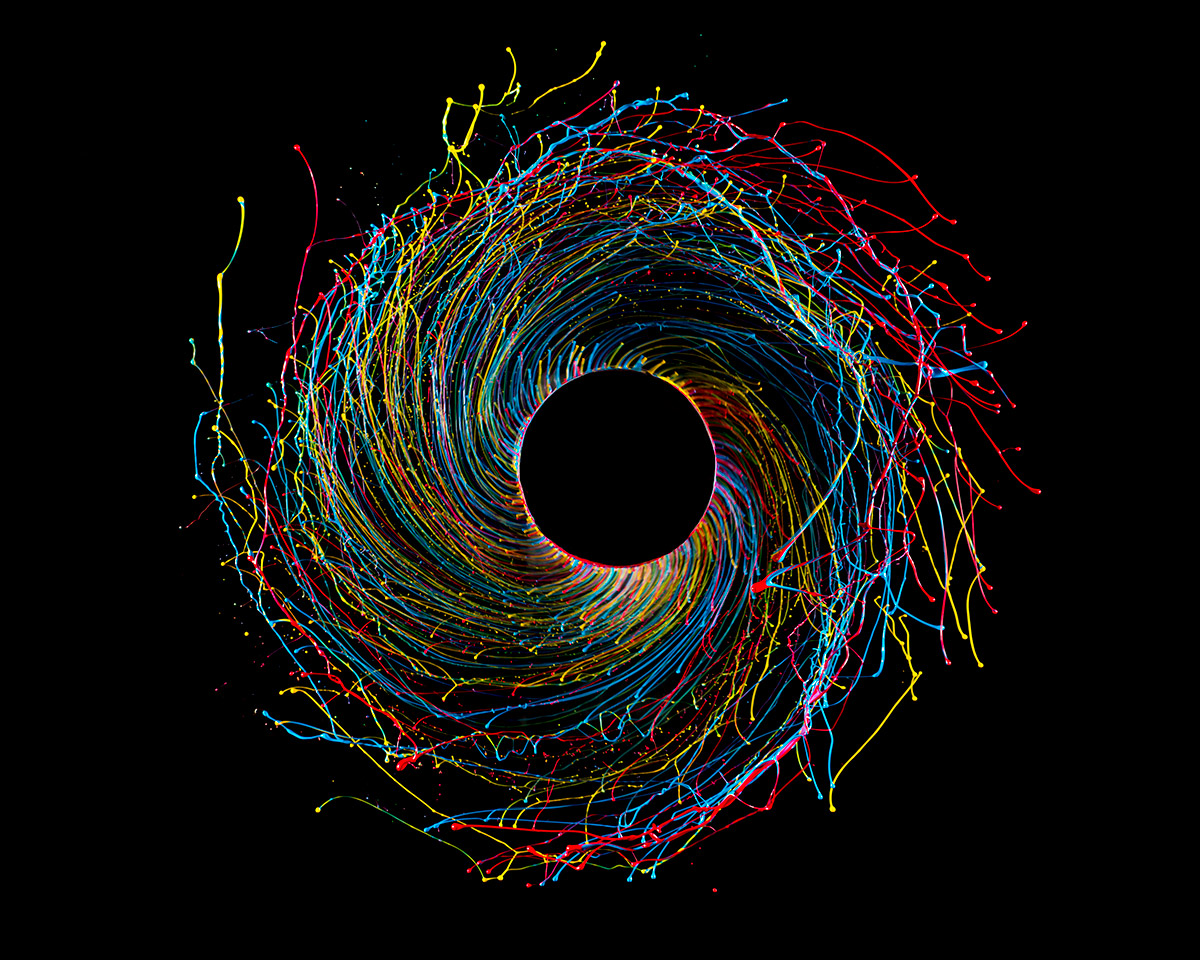
While Luminet’s monochrome picture depicted the total radiation in all wavelengths, astronomers Jun Fukue and Takushi Yokoyama imagined a visible-light photograph of an accretion disc. Luminet, Fukue and Yokoyama visualized thin accretion discs around Schwarzschild (stationary) black holes and a thick accretion disc around a Kerr (rotating) black hole from an almost edge-on viewpoint. Artist Fabian Oefner created an artwork that is a metaphor for a multicoloured accretion disc, representing the visible light from a rotating black hole (see artwork at the top of this article).
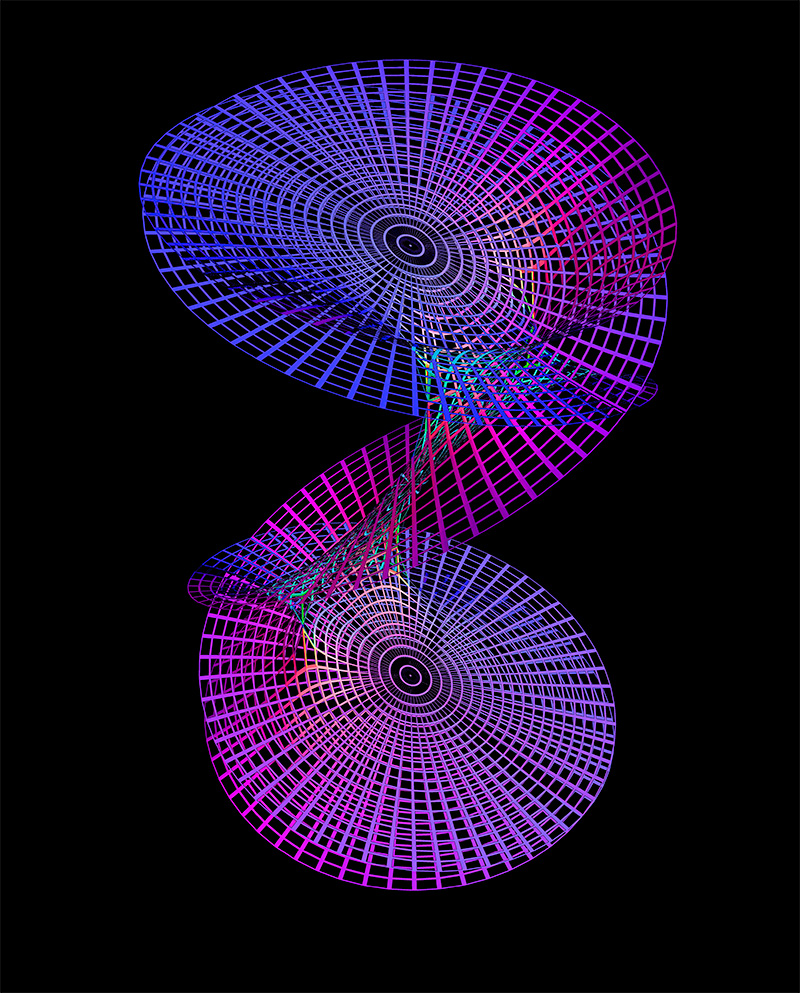
If a black hole is rotating, the speed at which it spins affects the diameter of the innermost stable circular orbit; the faster it spins, the smaller its diameter. If a Kerr black hole spins extremely fast, it will distort space–time at the inner edge of the accretion disc. A thin accretion disc around a maximally rotating Kerr black hole from an elevated viewpoint shows asymmetry of the disc’s inner edge as the result of frame-dragging; the rotating black hole “drags” space–time along.
Melissa Walter created a sculpture that is a metaphor for gravitational lensing. Light passes through cut paper that sways and curves, distorting the light like a gravitational lens. Walter, unlike many artists, understands the crucial distinction between a science illustration and an artwork. Under her maiden name, Melissa Weiss, she works for NASA, executing science illustrations of how a black hole might actually appear, such as the widely used image of Cygnus X-1 and its companion star. Under her married name, Melissa Walter, she creates artworks. Speaking about the development of her oeuvre, she said: “Abstraction has been the common thread throughout that evolution as it relates to humanity’s place in the cosmos.”
Eric Heller is a physicist who studies wave phenomena in quantum mechanics, acoustics and oceanography. He’s also a practising artist who creates digital images about scientific subjects. In Black Holes Merging he imagined the pattern two black holes might make when they spiral into each other (see above left).
The popularization of black holes
In the late 1970s popular-science books about black holes began appearing, including Isaac Asimov’s The Collapsing Universe: the Story of Black Holes (1977). Having earned a PhD in chemistry, Asimov drew on a deep knowledge of science and was a skilled storyteller. Another title that contributed to the popular fascination with black holes was Stephen Hawking’s A Brief History of Time: From the Big Bang to Black Holes (1988) and the 1991 film based on it. Inspired by the words of Hawking, the Italian art collective Opiemme painted letterforms surrounding a long shape that symbolizes an event horizon.
Carl Sagan’s book Cosmos (1980) sold five million copies internationally. The related TV series, Cosmos: a Personal Voyage (1980), was hosted by Sagan and shown in 60 countries to 400 million viewers. A sequel, Cosmos: a Space–time Odyssey (2014), hosted by Neil deGrasse Tyson, was shown in 125 countries to 135 million viewers. Sagan and Tyson described many scientific topics, including black holes, which were brought to life by animators.
The impact of these popularizations was felt around the world, and artists in Asia mixed Western science with Eastern philosophy and history. Cai Guo-Qiang was in his 20s when he began experimenting with gunpowder as an artistic medium. When you explode a small amount of gunpowder on paper, it leaves a mark. Cai called these works “gunpowder drawings”. In 1986, at age 29, he moved from his native China to Japan and became enthralled by popular books about astrophysics, especially A Brief History of Time and Cosmos, which he read in translation.
Cai said: “When I came to Japan, my encounters with the theories of 20th-century astrophysics were very significant to me. The concepts of the Big Bang, black holes, the birth of stars, what is beyond the universe, time tunnels, how to leap over great distances of time and space and dialogue with something infinitely far away – these ideas were still not commonly in circulation in China at the time. They were an eye-opener for me. At the same time, many of these ideas have similarities with traditional Chinese views, with which I was familiar, of metaphysics and the universe.”
In 1991 Cai created large gunpowder drawings on paper mounted on wood panels, such as The Vague Border at the Edge of Time/Space Project. Then he joined the wooden panels together, transforming them into traditional Chinese folding screens. He called the series Primeval Fireball: the Project for Projects because his drawings, like the cosmos, exploded into existence.
Lucas J Rougeux was inspired when in 2014 astronomers watched as what appeared to be a cloud of dust (G2) approached Sagittarius A*. They expected the space cloud to be sucked into the black hole, but it survived the encounter. (Astronomers now believe that G2 was a binary star system that orbited the black hole in tandem, eventually merging into an extremely large star.) After learning about G2, Rougeux created a series of artworks about black holes (see above) that were shown in a 2022 exhibition titled The Soul Gravity—Guided to Black. The artist said, “The delicacy and amorphous nature of a space cloud is directly connected to my own sense of queer identity…I am a cloud of space dust. I am a collection of particles dealing with depression. I am weaving through waves of space–time and isolation. My work is the product of this existentialism, loneliness and search for a connection to the sublime.”
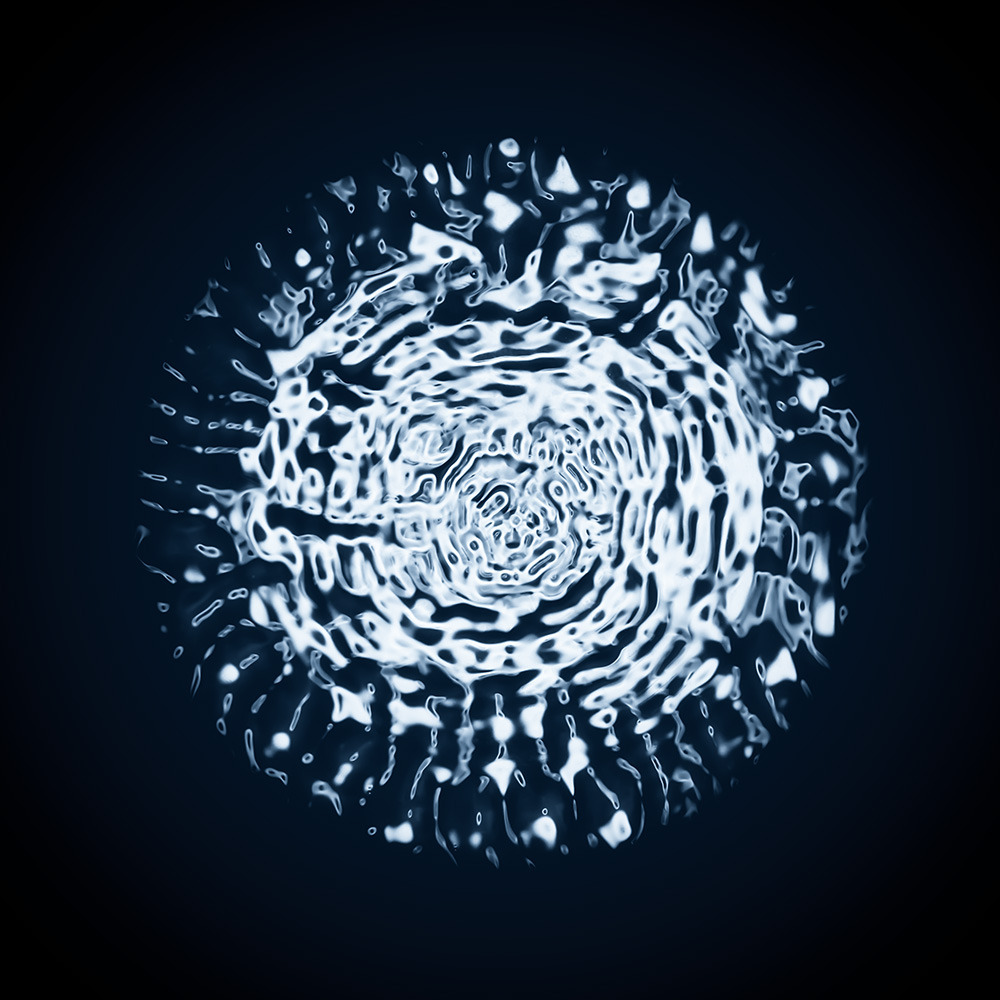
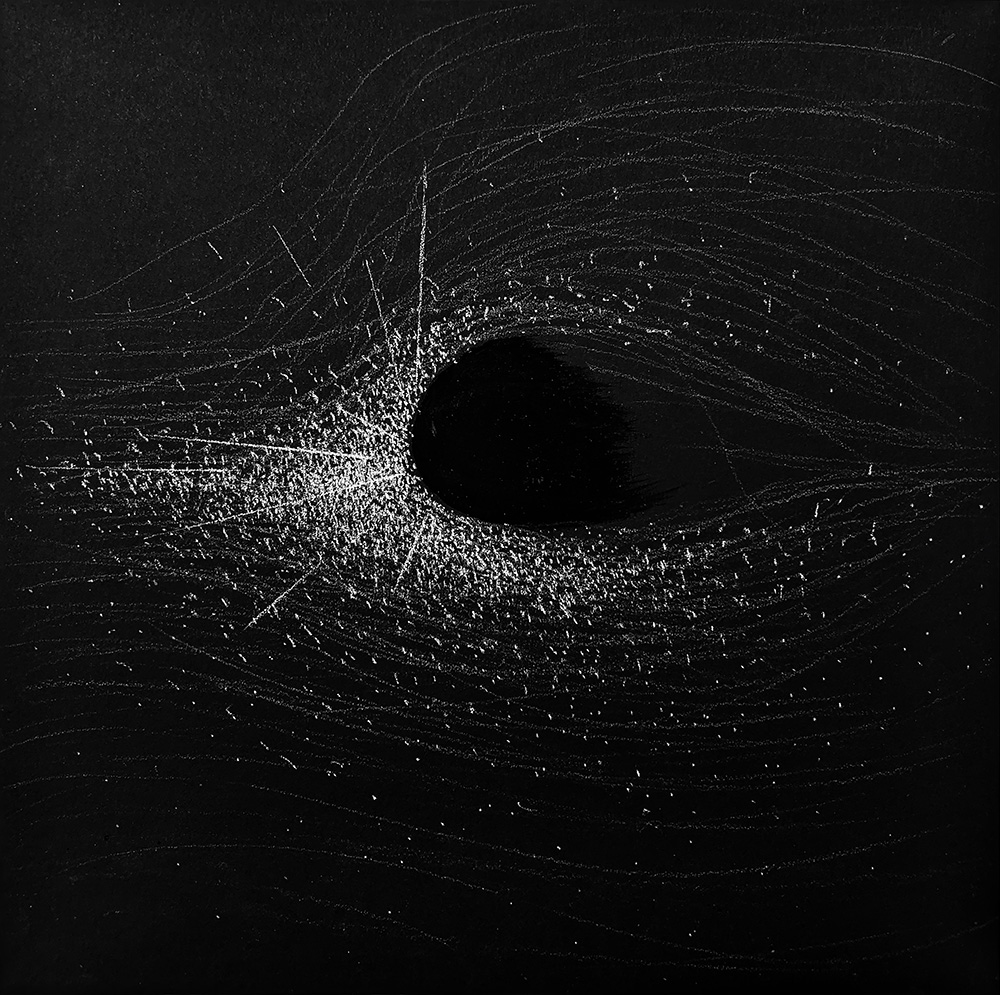
In 2022 NASA released a new sonification of the black hole at the centre of the Perseus galaxy cluster, which inspired the photographer John White. He painted the bottom of a petri dish black, filled it with water, and set it on top of a speaker. As he played the sound of the black hole through the speaker, the water began to vibrate. Shooting directly down at the petri dish with a macro lens and a halo light in a darkened room, he captured the vibration in a photograph titled Black Echo (see above).
Immersive art about black holes
Artists create immersive art – artworks the viewer can walk into – to enhance the immediacy of the experience. In 2016 the choreographer Wen-chi Su was an artist-in-residence at CERN, where she met the theoretical physicist Diego Blas, and they discussed the meaning of gravity in dance and astronomy. Su imagined what happens when a body falls into a black hole. Together with her production team, she directed a film in which the sets were animations and the movements of the dancer were captured by motion sensors. Additionally, a surround-sound system immersed the audience in a three-dimensional sound field.
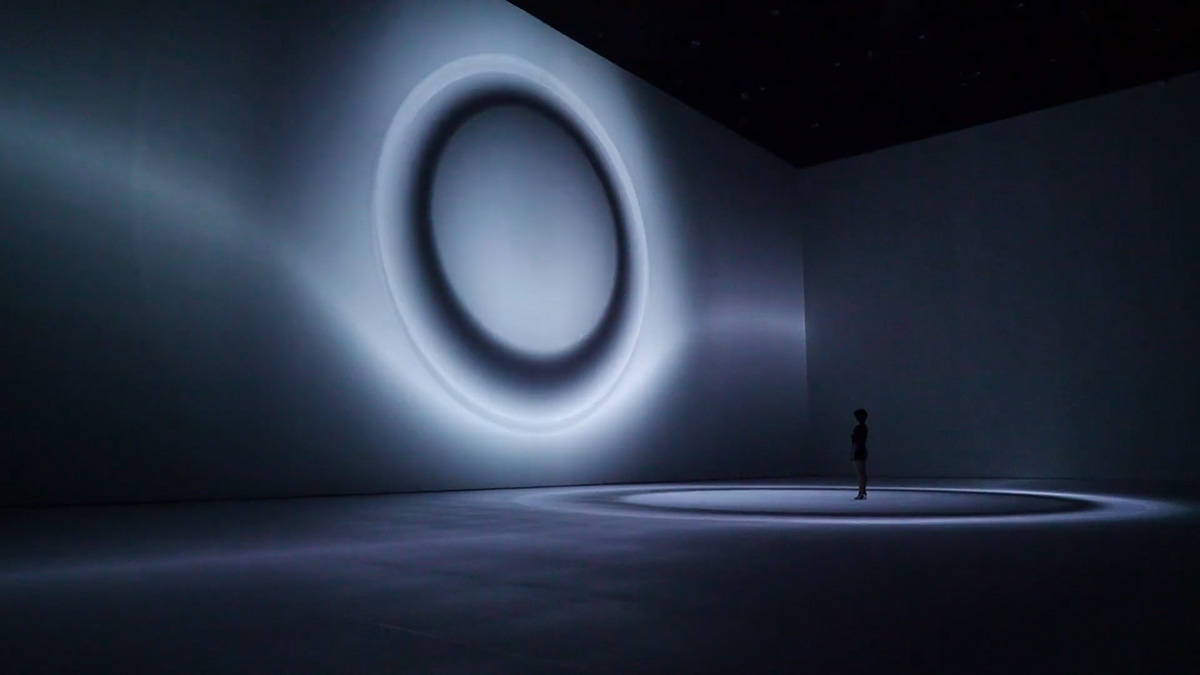
Cao Yuxi (James Cao) is a computer artist who created an artwork about a black hole that he titled Oriens (Latin for “Orient”), giving it the subtitle Immersive Black Hole because the viewer is able to walk around in the space of the artwork (see above). His projection of a sphere on the wall suggests a black hole. A circle symbolizing the event horizon is projected on the floor, and flashing, curving lights communicate distortions in space–time near the black hole.

The American artist Yambe Tam, who merges Western science with Chinese philosophy, has said: “Black holes are a reoccurring theme in my practice. Beyond my interest in theoretical physics, I see connections to the Buddhist philosophical concept of the void/emptiness/nothingness, which is shared more widely with other Eastern spiritual traditions. Rather than signifying a negative space or absence of something, void/emptiness/nothingness is a space of infinite potentiality. It is during the practice of zazen [silent meditation] that I most feel an embodied sense of this – the emptying of oneself, or dissolution of form and ego into pure being.”
Tam’s Cosmic Garden was created to resemble a Buddhist dry garden. From the ceiling hang several of the artist’s sculptures that take the form of bells. One of these sculptures, Wormhole Bell (see above left) has feedback microphones that turn the object into a self-resonating instrument, which helps induce a deep state of meditation. In astronomy, a wormhole is a hypothetical tunnel that connects separate regions of space–time. Tam says: “To me, black holes and the speculative, double-ended form of the wormhole are symbols of transformation – whether the breakdown of classical Newtonian physics to general relativity or the spiritual transcendence one feels in contemplative practices like zazen. Physically, travelling into a black hole is obliteration – a return to pure atomic matter. However, in more philosophical and spiritual terms, a wormhole is an unknowable space of no return, a portal to another side of reality.”
- This is an edited excerpt from Lynn Gamwell’s book Conjuring the Void: the Art of Black Holes (2025 MIT Press 208pp £41 hb). Reproduced with permission, copyright MIT Press. All rights reserved
The post Lure of the black hole: from science to art appeared first on Physics World.