Space Science
NASA’s IXPE Gets Fresh Look at Supernova
Mar 26, 2026, 4:58 PM
出典: NASA News
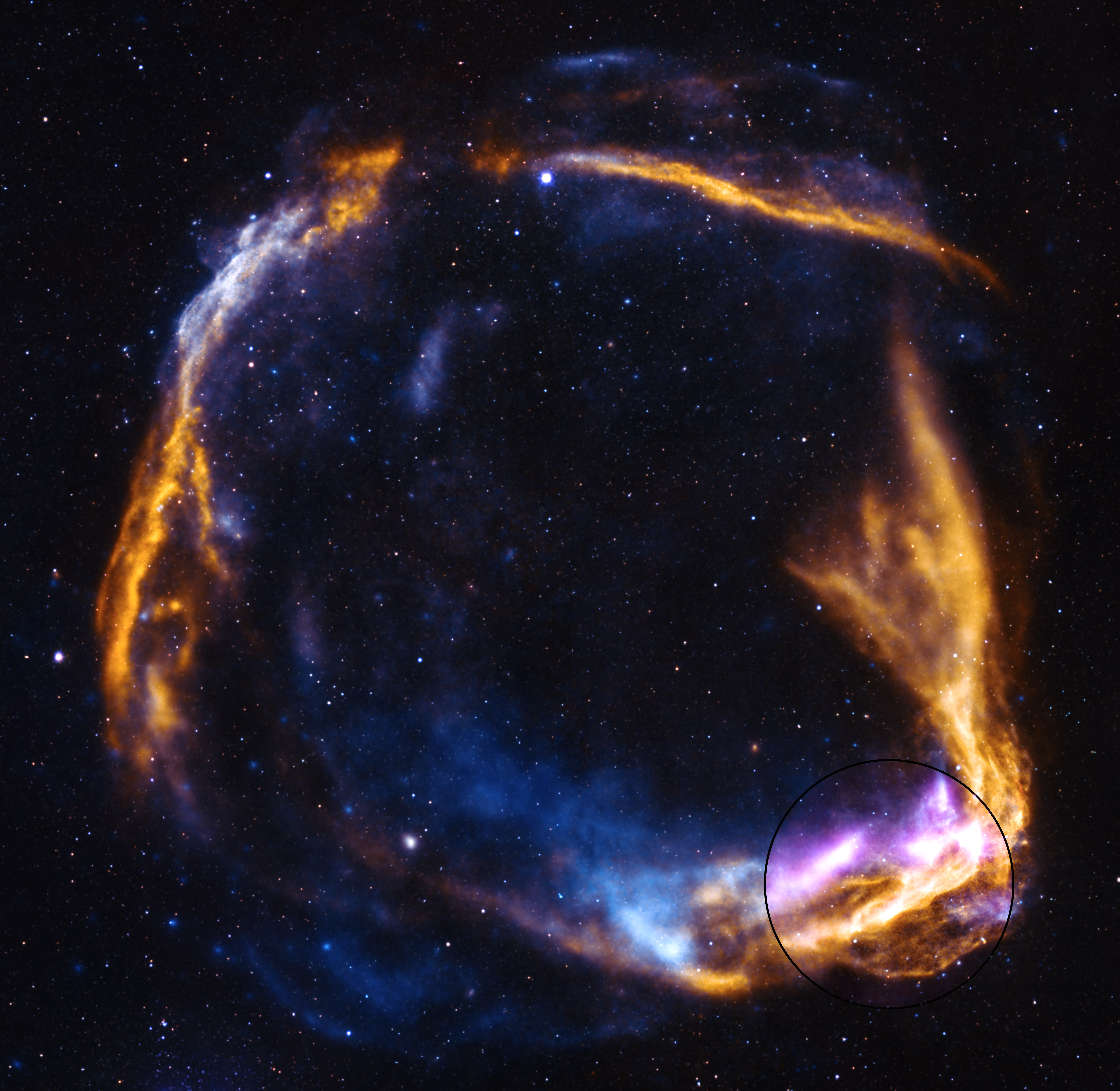
NASA’s IXPE (Imaging X-ray Polarimetry Explorer) mission has taken a new observation of a supernova, RCW 86, seen here in an image released on March 24, 2026. This observation helps fill in a fuller picture of what other telescopes have seen. The full image combines IXPE’s data with legacy observations from two other X-ray telescopes: […]
Details
X-ray: Chandra: NASA/CXC/SAO, XMM: ESA/XMM-NEWTON, IXPE:NASA/MSFC; Optical: NSF/NOIRLab; Image Processing: NASA/CXC/SAO/J. Schmidt
NASA’s IXPE (Imaging X-ray Polarimetry Explorer) mission has taken a new observation of a supernova, RCW 86, seen here in an image released on March 24, 2026. This observation helps fill in a fuller picture of what other telescopes have seen.
The full image combines IXPE’s data with legacy observations from two other X-ray telescopes: NASA’s Chandra and the ESA (European Space Agency) XMM-Newton telescope. The yellow represents low-energy X-rays, while blue shows high-energy X-rays detected by Chandra and XMM-Newton. The starfield in the image comes from the National Science Foundation’s National Optical-Infrared Astronomy Research Laboratory (NOIRLab).
Image credit: X-ray: Chandra: NASA/CXC/SAO, XMM: ESA/XMM-NEWTON, IXPE:NASA/MSFC; Optical: NSF/NOIRLab; Image Processing: NASA/CXC/SAO/J. Schmidt
Related Knowledge
mentions
X-ray Astronomy
X-ray astronomy is a branch of astronomy that studies celestial objects emitting X-rays. These high-energy emissions can provide insights into extreme environments, such as those found around black holes and neutron stars.
mentions
Supernova
A supernova is a powerful and luminous explosion that occurs at the end of a star's life cycle. This event can outshine entire galaxies for a short period and is a key process in the universe, contributing to the distribution of elements and the formation of new stars.