Space Science
NASA Awards Astrophysics Postdoctoral Fellowships for 2026
Mar 25, 2026, 4:00 PM
出典: NASA News
The highly competitive NASA Hubble Fellowship Program (NHFP) recently named 24 new fellows to its 2026 class. The NHFP enables outstanding postdoctoral scientists to pursue independent research in any area of NASA Astrophysics, using theory, observations, simulations, experimentation, or instrument development. Over 650 applicants vied for the 2026 fellowships, representing an oversubscription rate of 27 […]
Details
5 min read
NASA Awards Astrophysics Postdoctoral Fellowships for 2026
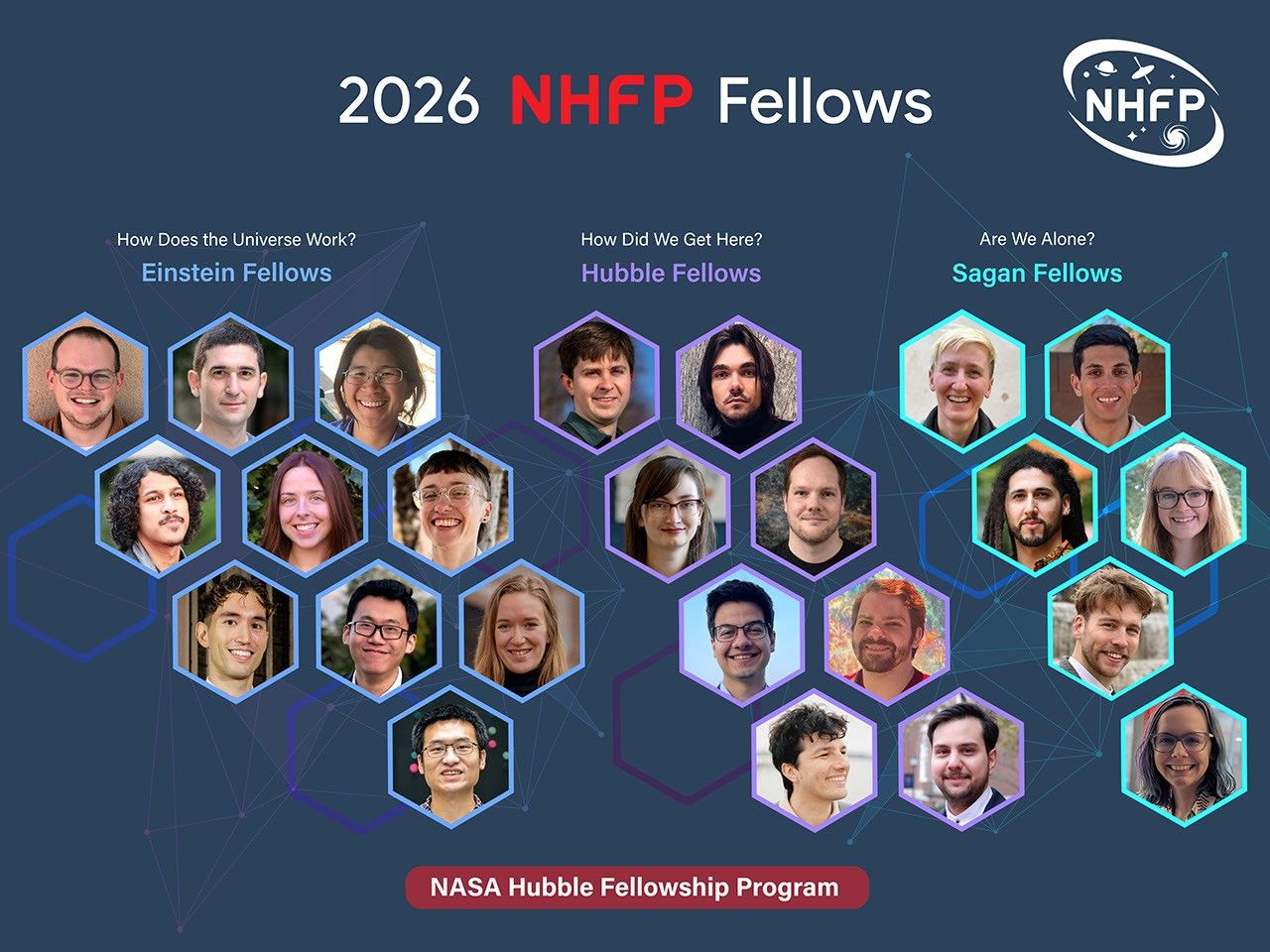
The class of 2026 NHFP Fellows is shown in this photo montage. The Einstein Fellows appear in the blue hexagons, the Hubble Fellows in the purple hexagons, and the Sagan Fellows in the teal hexagons.
Artwork: NASA, ESA, Joyce Kang (STScI)
The highly competitive NASA Hubble Fellowship Program (NHFP) recently named 24 new fellows to its 2026 class. The NHFP enables outstanding postdoctoral scientists to pursue independent research in any area of NASA Astrophysics, using theory, observations, simulations, experimentation, or instrument development. Over 650 applicants vied for the 2026 fellowships, representing an oversubscription rate of 27 to 1. Each fellowship provides the awardee up to three years of support at a U.S. institution.
Once selected, fellows are named to one of three sub-categories corresponding to three broad scientific questions that NASA seeks to answer about the universe:
- How does the universe work? – Einstein Fellows
- How did we get here? – Hubble Fellows
- Are we alone? – Sagan Fellows
“The 2026 class of the NASA Hubble Fellowship Program is comprised of outstanding astrophysics researchers who will advance NASA’s pursuit of big questions about how the universe works, how it evolved over time, and whether we’re alone in it,” said Shawn Domagal-Goldman, Astrophysics Division director, NASA Headquarters, Washington. “Through their compelling research, and by sharing the products of that work with the broader community, this year’s fellows will once again play an important role in creating our future and in inspiring future generations of students to be a part of that future. These scientists across the country will enhance the impact of U.S. academic institutions and will further American leadership in space-based astrophysics research.”
The list below provides the names of the 2026 awardees, their fellowship host institutions, and their proposed research topics.
The 2026 NHFP Einstein Fellows are:
- Hollis Akins, Princeton University, “Charting the Growth of the First Supermassive Black Holes through ‘Little Red Dots’”
- Dhayaa Anbajagane, Stanford University, “Building a Multi-Probe Approach to Primordial Physics”
- Hannah Gulick, California Institute of Technology, “Probing Compact Object Demographics with a New Generation of Space-Based Observatories”
- Casey Lam, Carnegie Observatories, “A Portrait of Galactic Black Hole Demographics”
- Benjamin Lehmann, Massachusetts Institute of Technology, “New Tools for Dark Matter Physics”
- Sizheng Ma, Johns Hopkins University, “Listening Beyond the Ring: A New Paradigm for Black Hole Spectroscopy”
- Megan Masterson, Harvard University, “The Dynamic Astronomical Sky as a Probe of Supermassive Black Holes”
- Simona Miller, City University of New York, “Probing High-mass Binary Black Hole Formation and Fundamental Physics with the Remnants of our Cosmos’ Most Extreme Collisions”
- Martijn Oei, Smithsonian Astrophysical Observatory, “The Widespread Impact of Megaparsec-scale Jets on the Cosmic Web”
- Frank Qu, Stanford University, “Mapping Dark Matter and Baryons Across the Universe with the Cosmic Microwave Background”
The 2026 NHFP Hubble Fellows are:
- James Beattie, Institute for Advanced Study, “The Glue Between the Stars: Unraveling Turbulence and Magnetism Across All Scales”
- Vedant Chandra, Massachusetts Institute of Technology, “Dark Matter at the Threshold of Galaxy Formation”
- Roman Gerasimov, University of Notre Dame, “New Frontiers in Galactic Archaeology”
- Jared Goldberg, Columbia University, “Massive Stars, Inside and Out: Bridging 1D and 3D Models of Stars and Supernovae”
- Vasily Kokorev, University of Texas at Austin, “The Cosmic Frontier: Uncovering Faint Galaxies that Ignited the Early Universe”
- Konstantinos Kritos, Stony Brook University, “Unveiling the Mystery of Massive Black Hole Seeds Through Gravitational and Electromagnetic Waves”
- Anna O’Grady, Carnegie Mellon University, “Stay Close to Go Far: Resolved Stellar Populations in Nearby Galaxies as Critical Benchmarks for Binary Evolution Models”
- David Setton, Johns Hopkins University, “A Multi-Wavelength View of Quenching Across Cosmic Time”
The 2026 NHFP Sagan Fellows are:
- Hayley Beltz, University of Kansas, “From Magnetic Fields to Measurable Signals: 3D MHD Modeling of Sub-Jovian Exoplanets”
- Rachel Bowens-Rubin, Harvard University, “From Ice Giants to Exorings: New Frontiers in Exoplanet Characterization with JWST & Roman CGI Direct Imaging”
- Collin Cherubim, University of Chicago, “Mass Fractionation in the Escaping Atmospheres of Small Planets, and the Hunt for Helium and Oxygen Worlds”
- Arvind Gupta, University of Arizona, “Securing the Doppler Legacy in the Hunt for Earth-like Exoplanets”
- Henrik Kneirim, California Institute of Technology, “Decoding the Formation of Extreme Giant Planets”
- Samantha Scibelli, National Radio Astronomy Observatory, “Zooming in on Prebiotic Chemistry at the Earliest Stage of Low-mass Star and Planet Formation”
An important part of the NHFP is the annual symposium, which allows Fellows the opportunity to present results of their research, and to meet each other and the scientific and administrative staff who manage the program. The 2025 symposium was held at the Space Telescope Science Institute in Baltimore. Topics ranged from understanding the atmospheric chemistry of nearby, rocky planets with NASA’s James Webb Space Telescope to observations of some of the earliest galaxies in the universe, and mapping the expansion of our universe with the latest data releases from the Dark Energy Spectroscopic Instrument.
More information about the 2026 NHFP Fellows is available online.
The Space Telescope Science Institute in Baltimore, Maryland, administers the NHFP on behalf of NASA, in collaboration with the Chandra X-ray Center at the Smithsonian Astrophysical Observatory in Cambridge, Massachusetts, and the NASA Exoplanet Science Institute and the Jet Propulsion Laboratory, in Pasadena, California.
Share
Details
Last Updated
Mar 25, 2026
Editor
Andrea Gianopoulos
Contact
Media
Claire Andreoli
NASA’s Goddard Space Flight Center
Greenbelt, Maryland
claire.andreoli@nasa.gov
Ann Jenkins, Christine Pulliam
Space Telescope Science Institute
Baltimore, Maryland
Related Terms

Related Knowledge
mentions
NASA Hubble Fellowship Program
The NASA Hubble Fellowship Program is designed to support outstanding postdoctoral researchers in the field of astrophysics. It provides funding for independent research that can include theoretical work, observational studies, simulations, and instrument development, fostering innovation and discovery in the study of the universe.
mentions
Astrophysics Research
Astrophysics research involves the study of the physical properties and behavior of celestial bodies and the universe as a whole. This field combines principles from physics and astronomy to understand phenomena such as the formation of stars, galaxies, black holes, and the cosmic microwave background.