Space Science
NASA Invites Media to Learn About Upcoming X-59 Test Flights
Mar 16, 2026, 7:48 PM
出典: NASA News
NASA will hold a media teleconference at 5:30 p.m. EDT on Thursday, March 19 to highlight plans for its X-59 quiet supersonic aircraft’s upcoming flight tests. The teleconference is set to take place after the X-59 is scheduled to complete its second flight, in California. For the media call, NASA leadership will join representatives from […]
Details
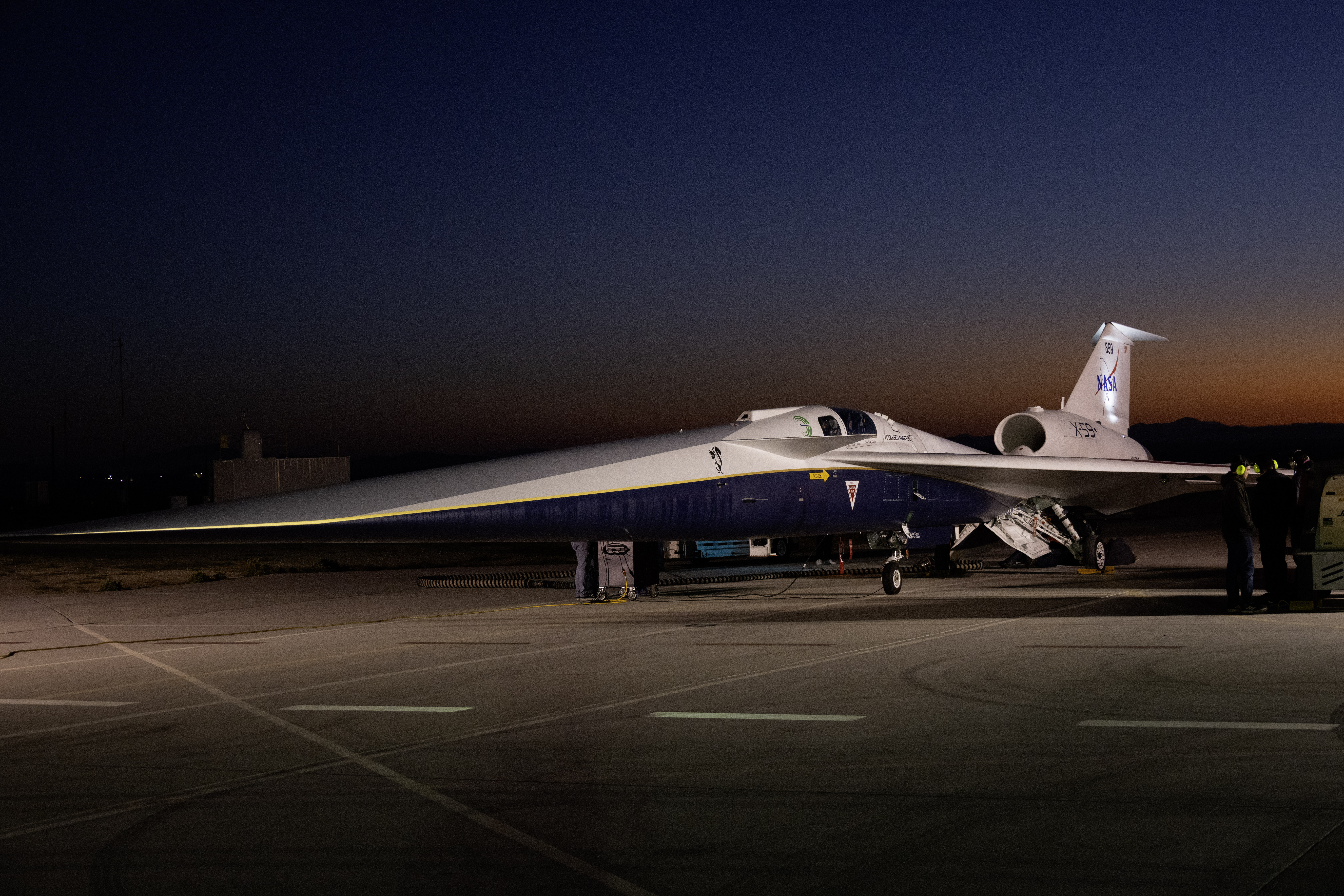
As its team prepared for second flight, NASA’s X-59 quiet supersonic aircraft underwent engine run testing on Thursday, March 12, 2026, at NASA’s Armstrong Flight Research Center in Edwards, California.
Credit: NASA
NASA will hold a media teleconference at 5:30 p.m. EDT on Thursday, March 19 to highlight plans for its X-59 quiet supersonic aircraft’s upcoming flight tests. The teleconference is set to take place after the X-59 is scheduled to complete its second flight, in California.
For the media call, NASA leadership will join representatives from the Quesst mission and contractor Lockheed Martin Skunk Works. The X-59’s test pilots will be available to answer questions about what it’s like to fly the aircraft and how they prepare for flights.
The news conference will stream on NASA’s YouTube channel. An instant replay will be available online. Learn how to watch NASA content on a variety of platforms, including social media.
Participants include:
- Amit Kshatriya, NASA associate administrator
- Cathy Bahm, project manager, Low Boom Flight Demonstrator, NASA’s Armstrong Flight Research Center, Edwards, California
- Peter Coen, Quesst mission integration manager, NASA’s Langley Research Center, Hampton, Virginia
- Jim “Clue” Less, X-59 test pilot, NASA Armstrong
- Nils Larson, X-59 test pilot, NASA Armstrong
- Pat LeBeau, Lockheed Martin X-59 project manager
To participate in the virtual call, members of the media must RSVP no later than two hours before the start of the event to: kristen.m.hatfield@nasa.gov. NASA’s media accreditation policy is available online.
For second flight, the X-59 will taxi from its hangar at NASA Armstrong, then take off and land at nearby Edwards Air Force Base. The aircraft will fly for roughly an hour, reaching a cruising speed of 230 mph at 12,000 feet before accelerating to 260 mph at 20,000 feet.
This flight will kick off a series of flights known as envelope expansion, during which NASA will gradually take the X-59 faster and higher to ensure the aircraft’s safety and assess its performance. This phase will be followed by flights assessing the X-59’s unique acoustic profile. The X-59 is the centerpiece of NASA’s Quesst mission and was developed to fly supersonic, or faster than the speed of sound, without generating loud sonic booms.
Through Quesst, NASA is working to make commercial supersonic flight over land possible, dramatically reducing travel time in the United States or anywhere in the world.
To learn more about X-59 visit:
https://www.nasa.gov/quesst-media-resources
-end-
Rob Margetta
Headquarters, Washington
202-358-0918
robert.j.margetta@nasa.gov
Kristen Hatfield
NASA Langley, Virginia
757-817-5522
kristen.m.hatfield@nasa.gov
Related Knowledge
mentions
Supersonic Flight
Supersonic flight refers to the flight of an object through the air at speeds greater than the speed of sound, which is approximately 343 meters per second (1,125 feet per second) at sea level. This type of flight creates shock waves, resulting in a sonic boom, and poses unique engineering challenges and considerations for aircraft design.
mentions
Quiet Supersonic Technology
Quiet supersonic technology aims to reduce the noise produced by supersonic aircraft, particularly the sonic boom, to allow for commercial supersonic flight over land. This involves innovative design strategies and materials that minimize noise while maintaining performance and speed.